En un futuro post les pondré otro vídeo, pero explicando un poco hacia donde va el futuro de la red. Si la Web 2.0 los asombra, no han visto nada.
sábado, marzo 07, 2009
Como internet aprende de nosotr@s y nosotros de internet
En un futuro post les pondré otro vídeo, pero explicando un poco hacia donde va el futuro de la red. Si la Web 2.0 los asombra, no han visto nada.
miércoles, noviembre 19, 2008
El banco de ideas de Barack Obama
Soros-Funded Democratic Idea Factory Becomes Obama Policy Font
By Edwin Chen
Nov. 18 (Bloomberg) -- Three blocks from the White House, on the 10th floor of a sleek glass building, young workers pound at computers, with giant flat-screen TVs overhead. It has the look and feel of a high-tech startup.
In many ways it is. The product is ideas.
Thanks in part to funding from benefactors such as billionaire George Soros, the Center for American Progress has become in just five years an intellectual wellspring for Democratic policy proposals, including many that are shaping the agenda of the new Obama administration.
Much as the Heritage Foundation provided intellectual heft for the Republican Party in the 1980s, CAP has been an incubator for liberal thought and helped build the platform that triumphed in the 2008 campaign.
``What CAP has done is recapture the role of ideas as an important political force, something the Republicans had been better at for 25 years,'' said Walter Isaacson, president of the Aspen Institute, a non-partisan policy-research organization in Washington.
CAP's president and founder, John Podesta, 59, former chief of staff to President Bill Clinton, is one of three people running the transition team for president-elect Barack Obama, 47. A squadron of CAP experts is working with them.
Some of the group's recommendations already have been adopted by the president-elect.
Withdrawal of Troops
These include the center's call for a gradual withdrawal of U.S. troops from Iraq and a buildup of forces in Afghanistan, a plan for universal health coverage through employer plans and proposals to create purchasing pools that allow small businesses to spread the cost among a larger group of workers. Obama has endorsed much of a CAP plan to create ``green jobs'' linked to alleviating global climate change.
CAP also is advocating the creation of a ``National Energy Council'' headed by an official with the stature of the national security adviser and who would be charged with ``transforming the energy base'' of the U.S. In addition, CAP urges the creation of a White House ``office of social entrepreneurship'' to spur new ideas for addressing social problems.
To help promote its ideas, CAP employs 11 full-time bloggers who contribute to two Web sites, ThinkProgress and the Wonk Room; others prepare daily feeds for radio stations. The center's policy briefings are standing-room only, packed with lobbyists, advocacy-group representatives and reporters looking for insights on where the Obama administration is headed.
`Premier Progressive'
``The center is the premier progressive think tank in Washington,'' said Mark Green, head of the New Democracy Project, an urban-affairs institute in New York.
Just eight days after the Nov. 4 election, CAP released a 300,000-word volume called ``Change for America: A Progressive Blueprint for the 44th President'' that offers advice on issues such as economic revival and fixing the Federal Emergency Management Agency. Work on the book began almost a year ago.
CAP, which has 180 staffers and a $27 million budget, devotes as much as half of its resources to promoting its ideas through blogs, events, publications and media outreach.
The center's future was far from certain in 2003, when wealthy donors such as Soros and film producer Stephen Bing gave $10 million or more to fill what they believed was an intellectual void in the Democratic Party and create a vehicle to produce an agenda for the party's eventual return to power.
Heritage Foundation
Podesta modeled the center on the Heritage Foundation, which became the go-to policy-research organization in 1981 when newly elected President Ronald Reagan embraced its conservative ideas embodied in a book called ``Mandate for Leadership.'' Heritage was just seven years old.
CAP and Heritage have something else in common.
``Others strive to be objective, we don't,'' said Jennifer Palmieri, CAP's vice president for communications.
Podesta likes to say, ``we're not a think tank, we're an action tank,'' said Dan Weiss, an environmental activist who joined CAP last year.
CAP isn't the only Democratic-leaning research organization in Washington with enhanced cachet after Obama's election.
The 92-year-old Brookings Institution, for example, has advisers in Obama's inner circle, including economist Jason Furman and foreign-policy expert Susan Rice. Others are working either part-time or full-time in the Obama transition.
Podesta's center isn't even among the biggest or best- funded. Brookings has a staff of more than 400 and an annual budget of $48 million. Heritage has a staff of 200 and a budget of $60 million. The American Enterprise Institute, which has close ties to the administration of President George W. Bush, has about 140 staffers, including Lynne Cheney, wife of Vice President Dick Cheney, and a budget of $28 million.
Influence
Yet CAP may be the most influential. In addition to Podesta, at least 10 other CAP experts are advising the incoming administration, including Melody Barnes, the center's executive vice president for policy who co-chairs the agency-review working group and Cassandra Butts, the senior vice president for domestic policy, who is now a senior transition staffer.
``John understood that ideas have power in this town, and he brought in super-bright people whose ideas have become essential reading,'' Isaacson said.
CAP's successes offer a lesson for Republican-leaning groups, said James McGann, a professor at the University of Pennsylvania in Philadelphia who tracks policy groups.
``They've shown that one has to constantly innovate and be responsible to an ever-changing demographics and electorate, and have policies that are responsive to that,'' McGann said.
jueves, agosto 14, 2008
Richard Dawkins: la ciencia es extraña ya que ataca al sentido común, generalmente engañoso...
miércoles, agosto 06, 2008
La epidemia de colera de 1854 en Londres y la invención de la ciudad moderna
Una animación muy didáctica explica de qué se trata El Mapa Fantasma:
El genio de Charles Darwin, el primer capítulo de la serie
viernes, junio 20, 2008
Teofobia

miércoles, junio 18, 2008
¿Quién es el mayor pensador moderno?
The e-mail gods recently delivered this interesting query from a reader named Derek Wilhelm:
I go to the University of Richmond, which requires [us] to take a class called Core, where we read famous historical books. (Gandhi, Marx, Plato, Augustine, just to name a few). Anyway, my question for you is: Who do you think is the greatest modern-day thinker?
I love this question. It first requires you to define what a “thinker” is, and also raises the question of what incentives exist in the modern world to be a thinker. Also, is someone a great thinker if they’re never able to communicate their thoughts to a broad audience?
On a related note: The Times recently ran a piece about a rise in college philosophy majors; interestingly, the Wall Street Journal published a piece shortly thereafter (sorry, can’t find a link, but here’s a reprint of the pertinent info) ranking the first-year salaries for 16 selected college majors: engineers were first (at $48,707) and philosophers were dead last (at $28,234).
Once you’ve thought about what it means to be a thinker, then comes the hard part of thinking about who best fits the description.
So who are your nominees, and why?
Darwinmania
Darwinmania!
The party is about to begin.

In a week or so, the trumpets will sound, heralding the start of 18 months of non-stop festivities in honor of Charles Darwin. July 1, 2008, is the 150th anniversary of the first announcement of his discovery of natural selection, the main driving force of evolution. Since 2009 is the 200th anniversary of Darwin’s birth (Feb. 12), as well as being the 150th anniversary of the publication of his masterpiece, “On the Origin of Species” (Nov. 24), the extravaganza is set to continue until the end of next year. Get ready for Darwin hats, t-shirts, action figures, naturally selected fireworks and evolving chocolates. Oh, and lots of books and speeches....
Más en Citius64:
- La especie humana aún evoluciona.
- El siempre humilde Benedicto XVI ataca a Darwin.
- National Geographic demuestra con evidencias (y no con dogmas de fe) porque Darwin tiene razón en su descubrimiento.
- La revista Science documenta estudios de muchos científicos demostrando como la evolución no es una idea, sino la base misma de la biología.
- La misma revista presenta en un vídeo de 16 minutos a la evolución en acción.
martes, junio 17, 2008
¿Puede existir buena ciencia sin democracia?
Porque repite el mismo error de la extinta Unión Soviética: prohibe el debate libre de ideas.
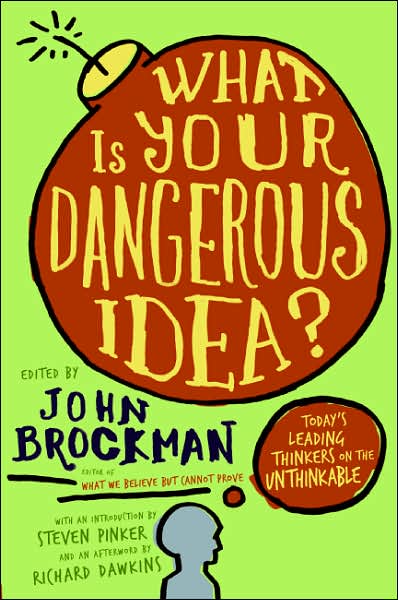
Edge.org explica qué le sucedió a un estupendo libro que iba a editarse en China. Una colección de 109 ensayos de algunos de los científicos y filósofos más prominentes de Occidente que se basaba en una pregunta que hizo Steven Pinker (profesor de neurolinguistica de Harvard) a colegas suyos: ¿cuál es tu idea más peligrosa? El libro se ha publicado con éxito por todo el mundo, pero la editorial china que compró los derechos dijo que no podría publicarse en el país asiático debido a unos contenidos que tenían conflicto con ciertas regulaciones. ¿Qué contenidos eran éstos? Los que hablaban de temas religiosos, del alma... Ante esta sorprendente acción Steven Pinker se pregunta:
"Everyone says that China will be the next scientific and economic power. Is this compatible with their ongoing rejection of open debate and exploration of ideas? Is a technologically advanced society compatible with anti-intellectualism and suppression of debate?"
jueves, junio 12, 2008
Susan Blackmore explica la ciencia de la memética o como las ideas tienen vida propia
miércoles, abril 23, 2008
Feliz cumple William Shakespeare
Uno de mis cantantes favoritos, Rufus Wainwright, canta Go ask Shakespeare, buena canción para celebrar su cumpleaños. El gran bardo inglés (1564-1616) tiene grandes frases, pero cito esta que es muy apropiada para los tiempos mexicanos actuales:
Cuidado con la hoguera que enciendes contra tu enemigo; no sea que te chamusques a ti mismo.
viernes, abril 18, 2008
martes, abril 15, 2008
Stephen Hawking explora grandes preguntas
Lleva décadas atrapado en su cuerpo, pero su mente es más libre que nunca (gracias a haberse convertido en un cyborg) y explora algunas de las preguntas que la ciencia visita ahora y seguramente contestará en un futuro cercano. 10 minutos de una conferencia del astrofísico británico en la reunión de TED en Monterey, California.
martes, marzo 11, 2008
Entrevistas con premios Nobel
martes, marzo 04, 2008
The Machine is Us/ing Us
jueves, febrero 28, 2008
¿Por qué las mujeres humilladas por la iglesia siguen en ella?
Castillo: «No me explico cómo las mujeres, tan marginadas, siguen yendo a la iglesia»

-¿Ha sido este Gobierno más sensible a las presiones de la Iglesia?
-El Gobierno del PSOE no ha sido consecuente. Debía haber sido más tajante, no en perseguir a la Iglesia o marginarla, sino en ponerla en su sitio. Lo primero que tendría que haber hecho es replantear los acuerdos entre el Estado y el Vaticano de 1979 en los que se conceden una serie de privilegios económicos, legales, docentes, que no los tienen otros confesiones.
-¿La Iglesia Católica es ahora más conservadora que cuando se firmó ese acuerdo?
-Mucho más. En la Iglesia ha habido el largo pontificado de Juan Pablo II, que ha sido muy conservador. El actual Papa es aún más conservador. En estas condiciones lo que se privilegia en la Iglesia son aquellos grupos incondicionalmente sumisos a las orientaciones que vienen de Roma, y no a los grupos que desde sus creencias en Jesucristo y el Evangelio consideran que deben adoptar otros comportamientos. En la nota de los obispos del 30 de enero se da a entender que en España para ser buen católico hay que ser derechas, y más en concreto del PP. Eso me parece una atrocidad. Hay personas que no estamos de acuerdo con el PP y nos consideramos buenos creyentes. Puede haber personas a la que se le provoque un conflicto interior.
-¿Cómo evolucionará la Iglesia en la próxima década?
-Las religiones evolucionan lentamente. No se les cambia en unos años. Necesitaría unos dirigentes más jóvenes. Estamos con falta de vocaciones y con las iglesias vacías y ponen para arreglar esto a un señor de 80 años. A ninguna institución se le ocurre. Si tiene problemas, una empresa multinacional, -porque al fin y al cabo la Iglesia es una gran multinacional religiosa-, no pone al frente a una gerontocracia como es el Papa y el Colegio de Cardenales. Pero la Iglesia, viendo que la comunicación con la sociedad y la cultura es más complicada, prefiere replegarse. Se produce un fenómeno de fundamentalismo. Anthony Giddens lo ha definido muy bien diciendo que el fundamentalismo es tradición acorralada. Y yo pienso que la Iglesia se ve así. No quiere reconocer que se equivoca y que tendría que cambiar. Se apoya en los círculos más conservadores, mientras la mayoría de la gente va por otro camino.
-¿Qué reformas cree que tendría que hacer la Iglesia?
-Lo primero sería replantear su sistema de gobierno. El Papa no puede ser un monarca absoluto. Tienen que replantearse las relaciones entre el Papa y los obispos, y hacer un reparto de poderes. Tendría que haber una descentralización del poder. En ninguna parte está legislado que el poder se tenga que ejercer así, de forma que la Iglesia entera esté pendiente de un solo hombre. Es una institución única en el mundo. Tendría que haber una mayor descentralización y darles mayor protagonismo a los laicos, sobre todo a las mujeres. No me explico cómo las mujeres, encima de todo lo que las marginan y excluyen, siguen yendo erre que erre a la iglesia.
-¿El feminismo no ha entrado en Iglesia?
-Que recen cada una en su casa. Una reforma de fondo iría a planteamientos teológicos, a la manera de entender a Dios. Mucha gente ve a Dios como alguien que castiga y amenaza. Y hay que repensar la moral, que se centra tan machaconamente en el sexo y olvida otros aspectos fundamentales. Cada día mueren 30.000 niños de hambre y yo no sé cuándo he oído hablar de eso en documentos eclesiásticos. Lo hacen de pasada. Se le da más importancia al tema del condón que a la muerte de 30.000 niños al día.
-¿Es absurdo?
-No tiene ni pies ni cabeza. También habría que reformar la liturgia, que tiene rituales de la alta Edad Media. Totalmente anacrónica.
martes, febrero 26, 2008
La Enciclopedia de la Vida se abre

Es el tipo de noticias que suenan míticas, o borgianas. Imaginénse un libro casi infinito, y que contiene en cada página la descripción de cada especie viva en la Tierra. El New York Times dice que el librito mediría 300 pies de largo... y el libro quedaría corto, porque aunque ahora se conocen 1.8 millones de especies, se cree que hay como 10 veces más. El Libro de la Vida. Algo que seguramente Darwin moriría por leer...
Pues científicos lo están escribiendo, pero no tiene hojas de papel, sino bits, ya que está en internet: la Enciclopedia de la Vida. Todos los animales, todas las plantas... Este jueves 28 de febrero abre sus páginas, con las primeras 30 mil. Y se espera que en una década tenga casi dos millones, una por especie.
El gran impulsor del proyecto es el prestigiado E.O. Wilson, afamado biólogo de la Universidad de Harvard, conocido por su estudio sobre hormigas - que ya lleva 60 años. Yo en lo personal amo su libro Consilience, donde aboga por la unidad del conocimiento.
Su financiamiento inicial, de 50 millones de dólares, es proveído por las fundación McArthur y Sloan. La talacha la están haciendo un conjunto de museos, universidades y centros de investigación, entre ellos la Comisión Nacional para Uso y Conocimiento de la Biodiversidad, de México.
jueves, septiembre 06, 2007
Andrew Sullivan por fin se casó, con Aaron Tone
Andrew Sullivan, uno de los intelectuales más reconocidos de Estados Unidos se casó hace unos días en Massachusetts, eso no sería noticia, si no fuera por que se casó con su pareja de hace muchos años, el pintor Aaron Tone. Esto cobra mayor relevancia a partir de que Sullivan ha sido desde hace 20 años el mayor impulsor del matrimonio para todos, incluidas claro, las parejas del mismo sexo. El amor fortalecer al matrimonio, sea de quien sea, afirma él, y el Estado no es nadie para decir qué amor es más o menos legitimo entre ciudadanos libres. Derechos iguales para ciudadanos iguales es el mensaje político de fondo.
En español Sullivan tiene un gran libro sobre ciudadanía y homosexualidad, Prácticamente normal (Alba Editorial, Barcelona, 1999). Y claro, su blog es uno de los más visitados de la red: www.andrewsullivan.com
Dos de sus lectores le mandaron estos correos:
Gay Marriage, Straight Marriage
06 Sep 2007 08:54 am
A reader writes:
I remember discussing the gay marriage issue with a friend in 2004 when many states, including my home state of Utah, were rolling out amendments preventing marriage equality. My friend, who had been married for a year at the time, pulled out the old Christianist saw defending the amendment, claiming that the sanctity of marriage must be defended.
I asked him how allowing two people to marry each other would affect his marriage. He said something along the lines that just knowing that anyone could get married made his marriage less special somehow. Of course he couldn't explain why. At the time, I argued that there was no way a gay wedding could have no impact on my own hypothetical wedding.
Now, however, having been married for 9 months to a wonderful woman, I've been surprised to realize my bigoted friend was right: gay marriage actually does affect mine. But not, however, in the negative way he thought it would.
Seeing the pictures of your wedding - so obviously filled with love and happiness - reminded me of the joy I felt on my wedding day. I remember being overwhelmed - in a good way - by the notion that I was choosing to spend the rest of my life with someone I loved dearly, and that all of our closest friends and relatives were with us simply to share that joy with us. Knowing that two people who love each other and are committed to each other can be married, regardless of gender, and experience the joy, strength and companionship I've experienced in my own marriage, makes my marriage all the more sacred to me.
Another writes:
I am 31 and have been with my partner Brian for three and a half years. I'm going to relish the day I get to have pictures such as these taken during a ceremony for marriage in California. Thanks for keeping the dream living on.
Viva los novios, y felicidades a los felices nuevos casados.
lunes, junio 18, 2007
Oakeshott, el conservador insumiso
Salman Rushie, ese querido de los liberales de todo Occidente, escritor disidente y pluma feroz ante el islam fundamentalista, aceptó ser un Caballero de Imperio Briánico este pasado sábado en una ceremonia encabezada por la Reina Isabel IIa.
A fines de 1981 Margaret Thatcher le ofreció al profesor Oakeshott un honor semejante: le dijo no gracias...
Cada vez más ese supuesto conservador se me hace más y más interesante...
lunes, junio 11, 2007
La rancia nostalgia por el comunismo

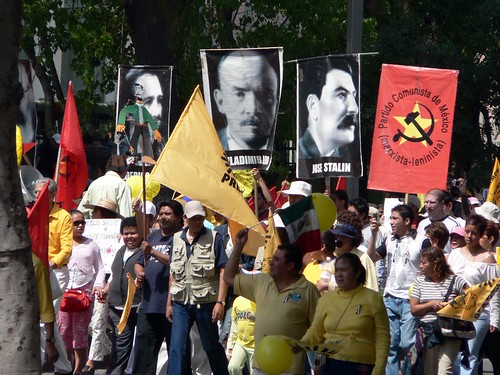
Que La Jornada le de espacio para que Fidel Castro escriba de su puño y letra... es un acto de nostalgia por el comunismo? O peor aún, ¿pleno apoyo al comunismo? El comunismo destruyó la vida de millones de personas, desde Rusia hasta Cuba, pero La Jornada no habla de ello, solo se refiere a los críticos del comunismo como "neoliberales". Pero este diario mexicano está lejos de ser el único elemento de la izquierda que añora el pasado. Como olvidar las grandes imagenes de Lenin y Stalin en el Zócalo en las "asambleas informativas" de López Obrador. ¿Por qué continúa el romance envenenado de la izquierda con el comunismo? Robert Service, autor de "Comrades: A World History of Communism", da su versión en New Statesman.
Para quienes añoran el comunismo, y que Castro siga gobernando ad infinitum en Cuba, creo sería buena idea fueran a ver La Vida de los Otros...
PD. ¿Y porqué los diputados quieren salvar a la democracia destruyéndola? Ahora quieren prohibir por ley los spots donde se hable mal de un candidato. La política Suavitel es el mejor antídoto para terminar los debates, las comparaciones, la discusión... y por ende la democracia efectiva.
June 17, 2008, 2:46 pm